Evidence without gimmicks
Letters, reports, text messages, newspaper clips, and notes should be distinguishable but readable. A consistent extract system is stronger than recreating every artifact literally.
Mystery interiors need readable narrative pages, unambiguous scene and timeline shifts, disciplined extracts for letters or evidence, and a repeatable series system. The design should support discovery without drawing attention away from the puzzle.
Every interior decision works together: type, measure, rhythm, hierarchy, and the white space around the text.
The template should remain quiet through ordinary pages and become expressive only where the manuscript needs a transition.
9Use 5 × 8, 5.25 × 8, or 5.5 × 8.5, a traditional readable serif, consistent chapter labels, and one extract style for evidence, notes, messages, or letters. Cozy series can use a light ornamental accent; procedural mysteries usually benefit from restraint.
Genre signals matter, but consistency and readability are what make the interior feel professionally produced across hundreds of pages.
Letters, reports, text messages, newspaper clips, and notes should be distinguishable but readable. A consistent extract system is stronger than recreating every artifact literally.
Mysteries depend on sequence. Dates, times, locations, and point-of-view changes should use a hierarchy readers can scan and remember.
Recurring trim, type, chapter openings, and ornaments make the catalog feel connected while covers carry most of the market-facing variation.
Chapter titles, running heads, and ebook contents should not accidentally reveal information the text intends to withhold.
Trim establishes the physical page. Gutter, outside, top, and bottom margins define the live area and need to account for binding, page count, genre convention, and reading comfort.
Typeface, size, line length, leading, indentation, paragraph spacing, hyphenation, and widow/orphan behavior create the texture readers experience for most of the book.
Part, chapter, heading, extract, caption, list, and special-content styles tell readers what kind of information they are seeing and how it relates to the whole.
Headers and folios help navigation but need suppression rules for opening pages, front matter, blank pages, and any page where they compete with the content.
Chapter openings, section openers, scene breaks, and page turns control rhythm. They need visual clarity and fallback behavior when reflow places a transition near a boundary.
Print resolves exact pages. EPUB preserves semantic reading order and adapts to the device. One source should produce both without forcing fixed-page assumptions into reflowable text.
A mystery may contain a police report, recipe, diary entry, email, newspaper excerpt, or handwritten note. Literal imitation can become unreadable in print and collapse in EPUB. The more durable approach is a small extract hierarchy that signals a different source while respecting the book’s body typography.
Use spacing, a secondary face or treatment, attribution, and careful indentation. Test long examples and narrow ebook screens. A device should not turn a clue into an inaccessible image or a horizontal-scroll problem.
If the reader needs to track days, locations, or investigators, the formatting should reduce cognitive load. Decide what appears at chapter level and what belongs in prose. Repeating a clear pattern helps readers notice when a timestamp or point of view changes.
Do not over-label ordinary scenes simply because the template allows it. Metadata works when it answers a recurring reader question. Otherwise it becomes noise and weakens the transitions that truly matter.
Mystery readers often follow a detective or setting across many books. Series order, also-by pages, next-book teasers, and newsletter invitations deserve the same maintained system as the chapters. Update early books as new volumes release.
Cambric’s one-time, unlimited-book model and local projects make that backlist work practical. Each title retains its source while the interior identity can remain consistent across the catalog.
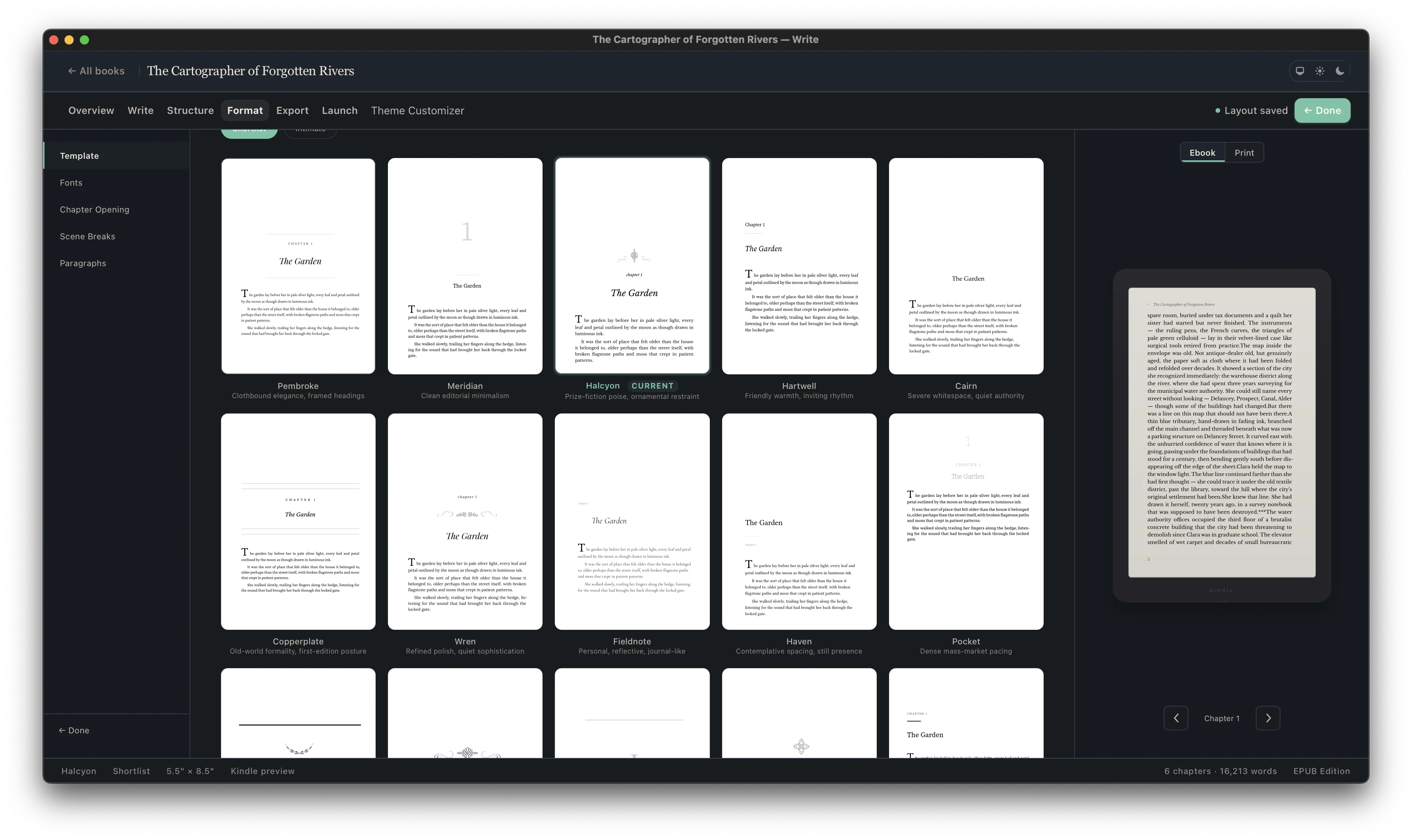
A template is useful only if it survives your content. Import or write the manuscript, choose an interior direction, set the edition, and inspect chapter titles, long pages, short pages, special extracts, images, front matter, and back matter in context.
Not every book needs every part. Decide intentionally, order the parts consistently, and test both the print and ebook navigation.
Define its place and hierarchy before final page composition.
Define its place and hierarchy before final page composition.
Define its place and hierarchy before final page composition.
Define its place and hierarchy before final page composition.
Keep the reader journey and future catalog updates in view.
Keep the reader journey and future catalog updates in view.
Keep the reader journey and future catalog updates in view.
Keep the reader journey and future catalog updates in view.
| Template element | Print edition | EPUB edition |
|---|---|---|
| Body typography | Exact type, size, line length, leading, and page composition | Styled defaults that yield to reader font and display choices |
| Chapter openings | Controlled page start and vertical position | Clear hierarchy without assuming a fixed physical page |
| Running heads and folios | Useful navigation with suppression rules | Omitted; the reading system provides location and navigation |
| Scene or section breaks | Spacing or ornament with page-boundary fallback | Semantic divider that remains visible as text reflows |
| Contents | Page-numbered list where the genre needs it | Linked navigation generated from structured headings |
| Images and extracts | Composed at exact size within the live area | Responsive treatment that survives narrow screens and enlarged type |
Use a consistent, readable extract style rather than imitating every artifact. Preserve text semantics so print and EPUB remain accessible.
Yes. Review chapter titles, table-of-contents entries, and running heads for accidental reveals, especially in ebook navigation.
A traditional readable body with a modest ornamental accent can support the tone. Keep illustration and display choices out of long-form reading text.
Reuse trim, core typography, opener hierarchy, scene language, and recurring book parts, then update back matter as the series grows.
Yes. Cambric exports a fixed-page print PDF and EPUB 3 from the same structured manuscript. Review each file against its destination before release.