How will the reader move through it?
A fast dialogue-heavy novel, a reference book revisited by topic, a poetry collection, and a photo-supported memoir need different hierarchy and page rhythm. Start with use, not decoration.
Explore the systems behind professional fiction, nonfiction, memoir, poetry, and series interiors—then apply a complete design to your real manuscript inside Cambric.





A useful interior template coordinates body type, line length, leading, paragraph treatment, heading hierarchy, chapter openings, scene breaks, running heads, page numbers, front and back matter, special extracts, and the exception rules that keep those elements professional across an entire manuscript.
That is why a generic Word file is rarely enough. Once the author adds a chapter, changes trim, inserts a map, or corrects prose, manual page breaks and section-level repairs begin to move. Cambric uses live typesetting so global rules recompose the book while the source stays editable.
Each blueprint explains the recurring structures, edge cases, print decisions, and ebook trade-offs that matter for that kind of book.
The best novel template does not advertise the template. It establishes readable type, quiet chapter rhythm, unmistakable scene breaks, and consistent running matter so the reader stays inside the narrative.
Open the blueprint →Romance readers move quickly and often continue through a series. The interior should support dialogue-heavy pages, clear point-of-view transitions, emotionally paced chapter openings, and back matter that turns a satisfied reader toward the next title.
Open the blueprint →Fantasy interiors often carry more structure than ordinary fiction: maps, named parts, epigraphs, multiple locations, appendices, glossaries, and long series. The template has to create atmosphere without turning worldbuilding into visual clutter.
Open the blueprint →Thrillers often use short chapters, rapid scene changes, timestamps, locations, and parallel timelines. The template should make every transition immediately clear without adding visual friction to a book built on pace.
Open the blueprint →Mystery interiors need readable narrative pages, unambiguous scene and timeline shifts, disciplined extracts for letters or evidence, and a repeatable series system. The design should support discovery without drawing attention away from the puzzle.
Open the blueprint →
Memoir combines the continuous reading needs of fiction with the supporting material of nonfiction: photographs, dates, documents, section breaks, captions, notes, and sometimes multiple timelines. The template should preserve voice while making context easy to follow.
Open the blueprint →
Nonfiction needs more than attractive pages. The interior has to expose structure, distinguish evidence and examples, support lists and figures, and remain navigable when the reader returns to find an idea later.
Open the blueprint →
Poetry is unusually sensitive to trim, line measure, stanza space, page turns, and alignment. The template must preserve the poem’s formal decisions while making the collection coherent as a physical and digital book.
Open the blueprint →
A series template is not a copied Word file. It is a controlled set of decisions—trim, typography, chapter hierarchy, scene language, running matter, recurring pages, and export discipline—that each volume can reuse without inheriting old mistakes.
Open the blueprint →A fast dialogue-heavy novel, a reference book revisited by topic, a poetry collection, and a photo-supported memoir need different hierarchy and page rhythm. Start with use, not decoration.
List parts, chapters, subheadings, scene breaks, dates, locations, extracts, figures, notes, exercises, appendices, and recurring back matter. The template must cover the real manuscript.
Test the longest chapter title, widest table, longest poem line, largest image, deepest list, or most complex extract before committing. Easy sample pages prove very little.
Trim changes line measure, page count, gutter, print cost, and the physical feel of the book. Typography and trim should be tested together on the actual text.
Print can depend on exact pages. A reflowable ebook cannot. Preserve hierarchy and identity while removing assumptions that only make sense on fixed paper.
A sample can hide everything difficult. Cambric shows the chosen system on your chapter titles, dialogue, long paragraphs, extracts, images, and back matter. You judge the pages that will actually be published.
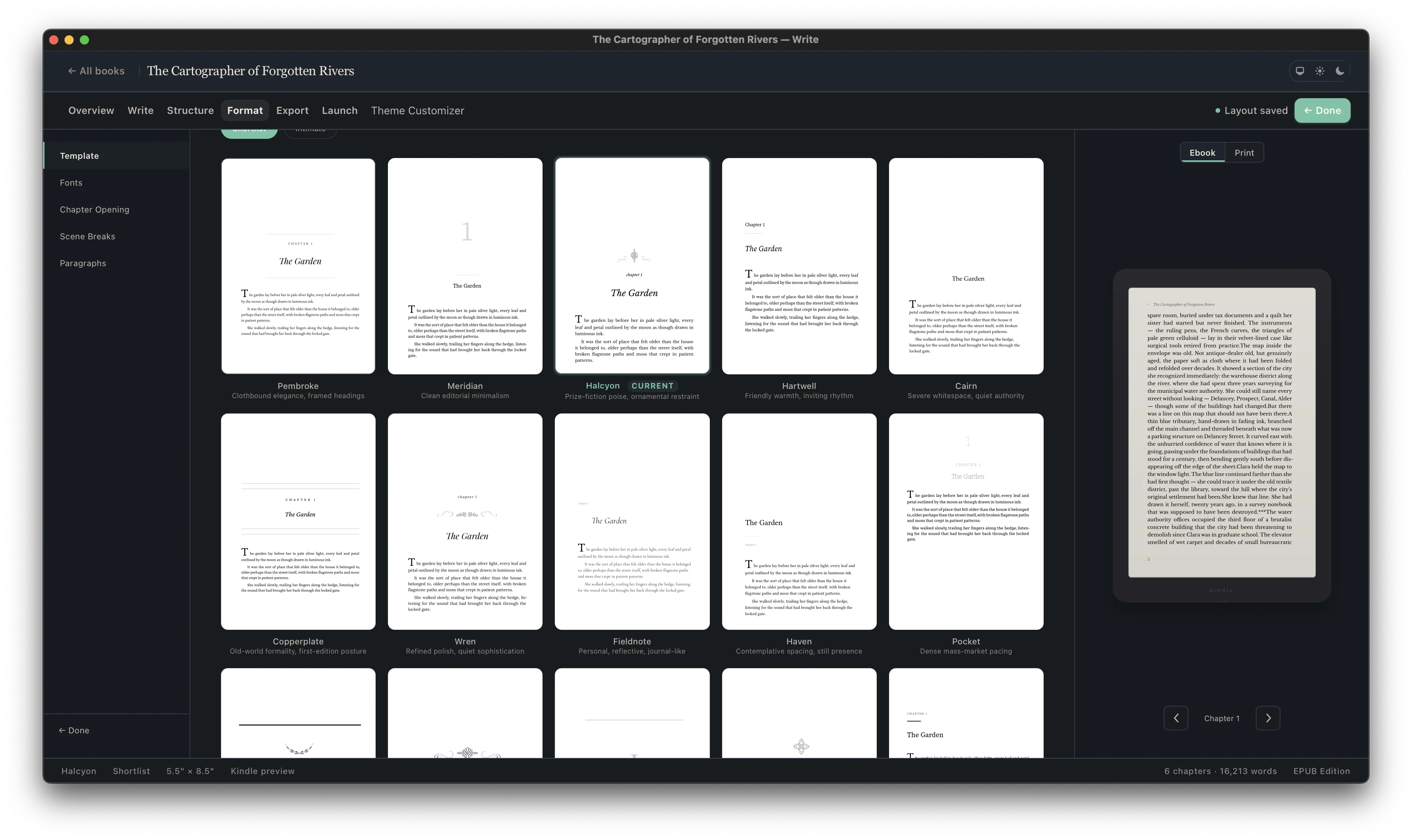
The decoration on a chapter opener is a tiny fraction of the reading experience. Evaluate body type, hierarchy, page rhythm, scene breaks, special content, and back matter before the flourish.
A real book has long headings, one-line chapters, extracts, images, odd front matter, and exceptions. A strong template adapts through rules and exposes where editorial changes are needed.
Blank paragraphs and space characters produce one accidental page, not a system. Define spacing through styles and structure so changes can safely recompose the document.
Running heads, exact page starts, and fixed white space belong to print. A reflowable ebook needs flexible structure. Related editions should share identity without pretending the media are the same.
No. These pages are professional interior blueprints: the structural and typographic decisions a template must solve. Cambric applies book-aware design systems without making you maintain a fragile Word layout.
Cambric includes more than 20 professional interior starting points. The right choice depends on genre, trim, manuscript structure, and the print and ebook editions you intend to publish.
Cambric exposes book and design settings while keeping the interior rule-based. The aim is enough control to fit the manuscript without turning every page into a manual layout job.
The hierarchy and identity can carry across editions, but print and EPUB have different layout behavior. Cambric generates format-appropriate outputs from the same structured source.
Start with the quietest design appropriate to the genre, then test the actual manuscript. Readability, clear structure, and reliable scene or heading treatment matter more than decorative novelty.