Visible information hierarchy
Part, chapter, section, and subsection levels need distinct scale and spacing without creating a poster on every page. Readers should understand location at a glance.
Nonfiction needs more than attractive pages. The interior has to expose structure, distinguish evidence and examples, support lists and figures, and remain navigable when the reader returns to find an idea later.

Every interior decision works together: type, measure, rhythm, hierarchy, and the white space around the text.
The template should remain quiet through ordinary pages and become expressive only where the manuscript needs a transition.
9Start with 6 × 9 for most general nonfiction, a readable serif or carefully tested sans-serif body, and a strict heading hierarchy. Define treatments for lists, quotations, callouts, tables, figures, captions, notes, and references before formatting chapters one by one.
Genre signals matter, but consistency and readability are what make the interior feel professionally produced across hundreds of pages.
Part, chapter, section, and subsection levels need distinct scale and spacing without creating a poster on every page. Readers should understand location at a glance.
Examples, exercises, case studies, tips, warnings, quotations, and summaries should each have one purpose and consistent treatment. Too many box types make the book harder to learn from.
Design for the chosen trim. A table built for a laptop screen may be illegible in a 6 × 9 book and impossible in reflowable EPUB without restructuring.
Print can use contents, index, notes, and cross-references. EPUB needs linked navigation and references that do not depend only on fixed pages.
Trim establishes the physical page. Gutter, outside, top, and bottom margins define the live area and need to account for binding, page count, genre convention, and reading comfort.
Typeface, size, line length, leading, indentation, paragraph spacing, hyphenation, and widow/orphan behavior create the texture readers experience for most of the book.
Part, chapter, heading, extract, caption, list, and special-content styles tell readers what kind of information they are seeing and how it relates to the whole.
Headers and folios help navigation but need suppression rules for opening pages, front matter, blank pages, and any page where they compete with the content.
Chapter openings, section openers, scene breaks, and page turns control rhythm. They need visual clarity and fallback behavior when reflow places a transition near a boundary.
Print resolves exact pages. EPUB preserves semantic reading order and adapts to the device. One source should produce both without forcing fixed-page assumptions into reflowable text.
Many nonfiction manuscripts use bold lines as improvised headings, tabs as tables, and manually numbered lists. Those visual cues are fragile. Define the semantic levels first: parts, chapters, headings, subheadings, figures, captions, lists, quotations, notes, and any recurring callout types.
Once the structure is stable, the template can make it visible in print and EPUB. This also improves revision: changing a heading level becomes a structural correction rather than a hunt for font sizes.
A table that cannot fit the trim may need to be simplified, rotated, split, or rewritten as prose. A callout that interrupts every page may belong in the main narrative. Formatting exposes these issues but cannot solve them without editorial judgment.
Test the worst examples early, not the easiest chapter. If the longest heading, widest table, deepest list, and largest figure work, the template is far more likely to survive the complete manuscript.
Print readers use page numbers, running heads, contents, index, and physical location. Ebook readers use linked contents, search, highlights, and device navigation. Cross-references such as “see page 83” may not survive reflow and should be reconsidered.
Cambric maintains a shared source while producing format-appropriate outputs. The identity and content remain consistent, but each edition uses the navigation tools its medium supports.
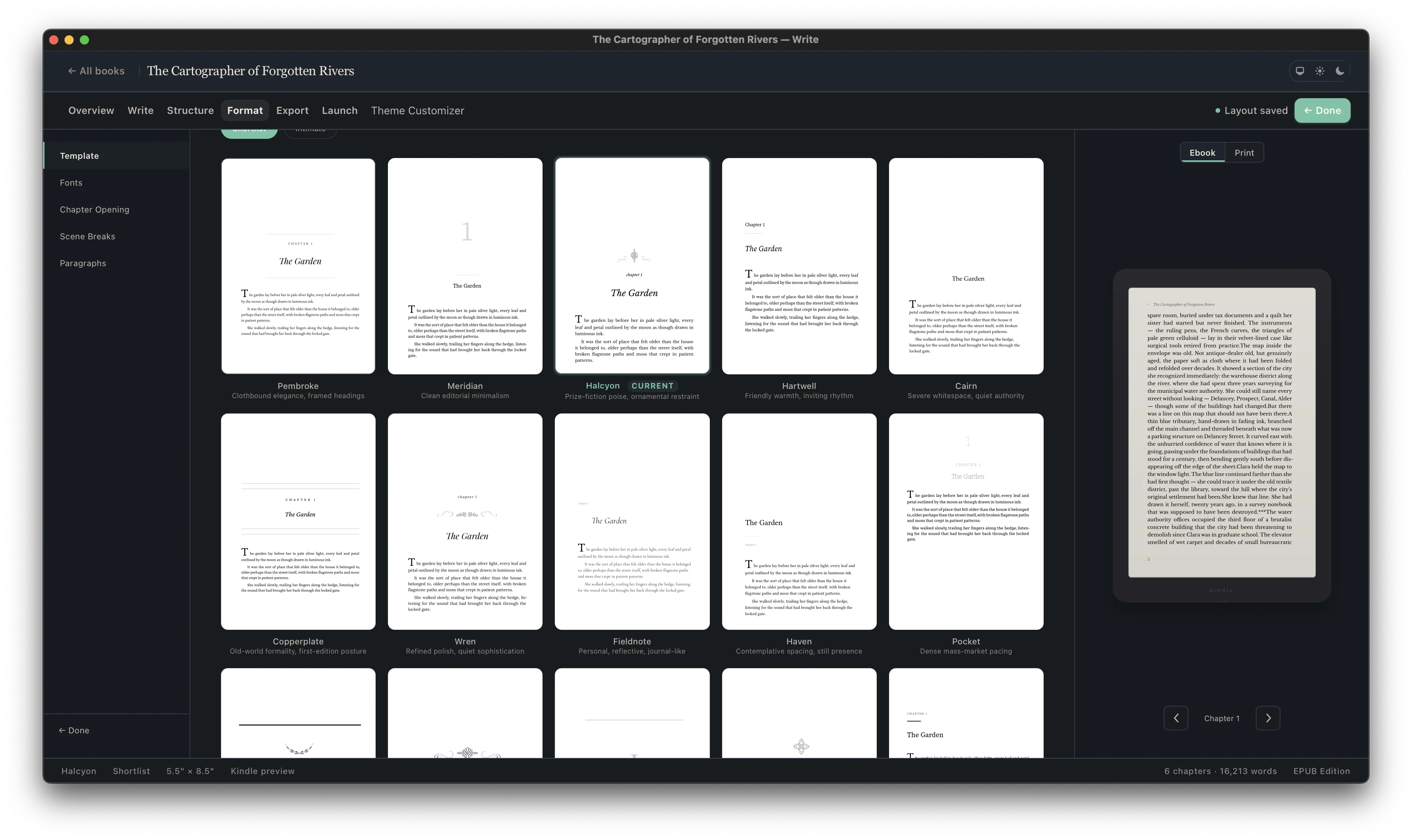
A template is useful only if it survives your content. Import or write the manuscript, choose an interior direction, set the edition, and inspect chapter titles, long pages, short pages, special extracts, images, front matter, and back matter in context.
Not every book needs every part. Decide intentionally, order the parts consistently, and test both the print and ebook navigation.
Define its place and hierarchy before final page composition.
Define its place and hierarchy before final page composition.
Define its place and hierarchy before final page composition.
Define its place and hierarchy before final page composition.
Keep the reader journey and future catalog updates in view.
Keep the reader journey and future catalog updates in view.
Keep the reader journey and future catalog updates in view.
Keep the reader journey and future catalog updates in view.
| Template element | Print edition | EPUB edition |
|---|---|---|
| Body typography | Exact type, size, line length, leading, and page composition | Styled defaults that yield to reader font and display choices |
| Chapter openings | Controlled page start and vertical position | Clear hierarchy without assuming a fixed physical page |
| Running heads and folios | Useful navigation with suppression rules | Omitted; the reading system provides location and navigation |
| Scene or section breaks | Spacing or ornament with page-boundary fallback | Semantic divider that remains visible as text reflows |
| Contents | Page-numbered list where the genre needs it | Linked navigation generated from structured headings |
| Images and extracts | Composed at exact size within the live area | Responsive treatment that survives narrow screens and enlarged type |
6 × 9 is common for general trade nonfiction because it supports longer lines, headings, figures, and reasonable page counts. Workbooks and technical books may need larger formats.
Use the fewest levels that express the real structure. Two or three beneath the chapter are often enough; too many levels create visual and navigational complexity.
Simple tables can, but wide or complex tables often fail on small screens. Simplify, restructure, or provide an accessible alternate representation.
Verify current product capabilities for automated indexing. An index is specialized editorial work and should not be promised merely because the book can be formatted.
Yes for conventional text-led nonfiction with supported structured elements. Highly technical or layout-heavy books may need professional composition.