Protect line integrity
An unintended wrapped line changes rhythm and sometimes meaning. Test the longest lines against the trim, typeface, size, indentation, and any line-number requirements.
Poetry is unusually sensitive to trim, line measure, stanza space, page turns, and alignment. The template must preserve the poem’s formal decisions while making the collection coherent as a physical and digital book.

Every interior decision works together: type, measure, rhythm, hierarchy, and the white space around the text.
The template should remain quiet through ordinary pages and become expressive only where the manuscript needs a transition.
9Choose trim after measuring the longest important lines. Establish poem title, subtitle or dedication, stanza, indentation, section opener, and notes styles. Use manual page breaks only for meaningful poem boundaries, and inspect every poem at final size.
Genre signals matter, but consistency and readability are what make the interior feel professionally produced across hundreds of pages.
An unintended wrapped line changes rhythm and sometimes meaning. Test the longest lines against the trim, typeface, size, indentation, and any line-number requirements.
Stanza spacing, space before titles, and the relationship among poems should be deliberate. Random blank paragraphs create fragile layout and inconsistent reflow.
Decide whether poems begin on fresh pages, whether sections use openers, and how facing pages interact. Page turns can be part of the editorial sequence.
Reflowable ebooks cannot guarantee fixed line measure or page composition. Some collections need careful adaptation or a print-first strategy rather than pretending every device will preserve the page.
Trim establishes the physical page. Gutter, outside, top, and bottom margins define the live area and need to account for binding, page count, genre convention, and reading comfort.
Typeface, size, line length, leading, indentation, paragraph spacing, hyphenation, and widow/orphan behavior create the texture readers experience for most of the book.
Part, chapter, heading, extract, caption, list, and special-content styles tell readers what kind of information they are seeing and how it relates to the whole.
Headers and folios help navigation but need suppression rules for opening pages, front matter, blank pages, and any page where they compete with the content.
Chapter openings, section openers, scene breaks, and page turns control rhythm. They need visual clarity and fallback behavior when reflow places a transition near a boundary.
Print resolves exact pages. EPUB preserves semantic reading order and adapts to the device. One source should produce both without forcing fixed-page assumptions into reflowable text.
A template that works for short lyric lines may fail on one long line with a deep indent. Identify the formal extremes: longest unbreakable line, deepest indentation, multi-column work, shaped poems, footnotes, epigraphs, and sequences that depend on facing pages. Test these before committing the trim.
Possible solutions include a wider trim, slightly different type, reduced indentation, an intentional hanging continuation, or a rotated/special page. The poet should choose the compromise; software should make the consequence visible.
Poetry manuscripts often carry spacing through repeated returns and spaces. That may look right in one document and collapse during conversion. Define stanza breaks, poem spacing, indentation levels, titles, dedications, and section transitions as meaningful rules.
Cambric’s structured workflow can apply consistent spacing and recompose the pages as settings change. Each poem still needs inspection because poetic form creates legitimate exceptions that ordinary prose rules cannot infer.
Straightforward verse with moderate lines can work well in EPUB when styles are restrained and tested. Concrete poetry, complex indentation, facing-page sequences, and highly page-dependent work may not. A fixed-layout ebook is a separate product with accessibility and device trade-offs.
Do not force a reflowable edition simply because distribution supports it. Publish the formats that preserve the work responsibly, and explain any intentional differences between print and digital editions.
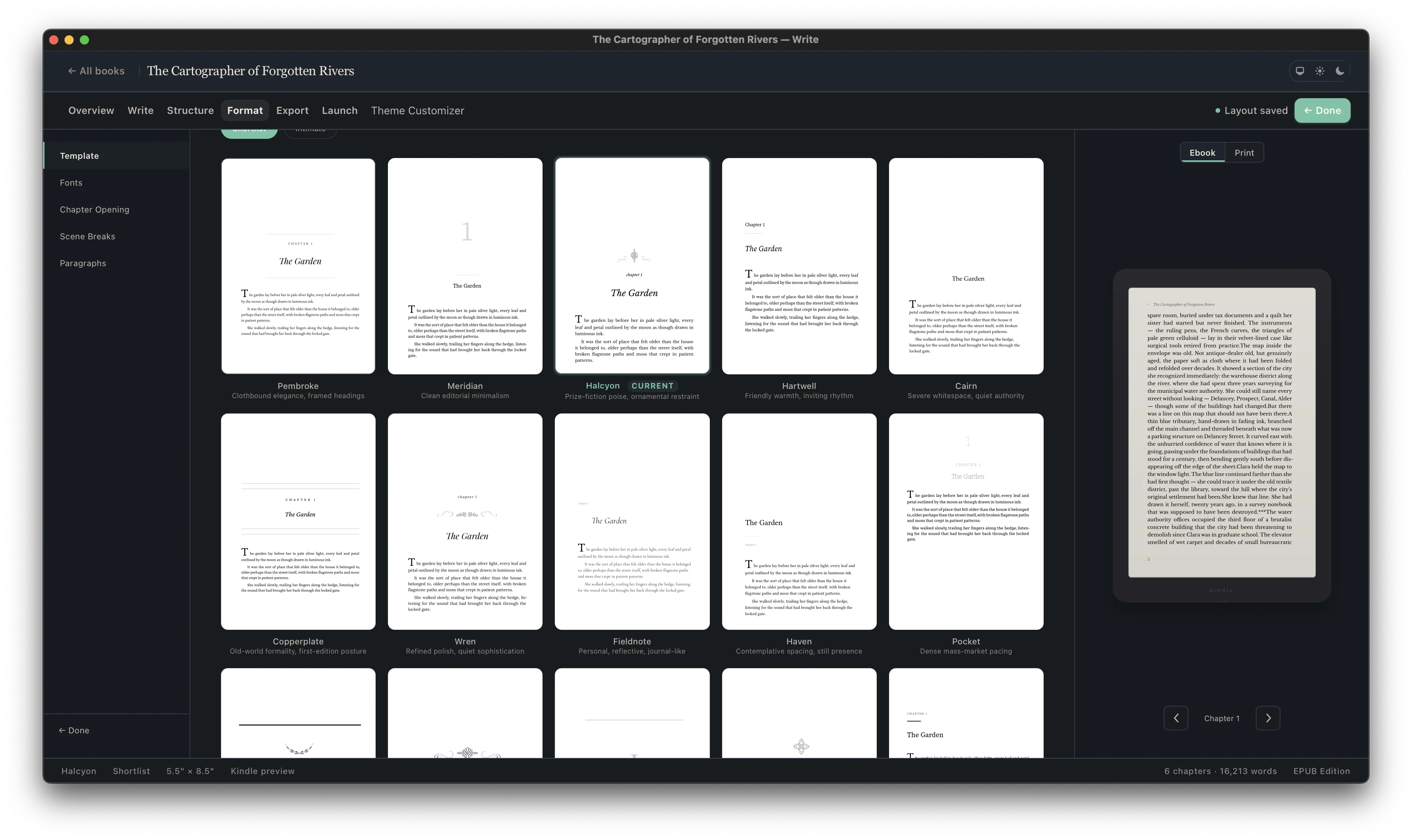
A template is useful only if it survives your content. Import or write the manuscript, choose an interior direction, set the edition, and inspect chapter titles, long pages, short pages, special extracts, images, front matter, and back matter in context.
Not every book needs every part. Decide intentionally, order the parts consistently, and test both the print and ebook navigation.
Define its place and hierarchy before final page composition.
Define its place and hierarchy before final page composition.
Define its place and hierarchy before final page composition.
Define its place and hierarchy before final page composition.
Keep the reader journey and future catalog updates in view.
Keep the reader journey and future catalog updates in view.
Keep the reader journey and future catalog updates in view.
Keep the reader journey and future catalog updates in view.
| Template element | Print edition | EPUB edition |
|---|---|---|
| Body typography | Exact type, size, line length, leading, and page composition | Styled defaults that yield to reader font and display choices |
| Chapter openings | Controlled page start and vertical position | Clear hierarchy without assuming a fixed physical page |
| Running heads and folios | Useful navigation with suppression rules | Omitted; the reading system provides location and navigation |
| Scene or section breaks | Spacing or ornament with page-boundary fallback | Semantic divider that remains visible as text reflows |
| Contents | Page-numbered list where the genre needs it | Linked navigation generated from structured headings |
| Images and extracts | Composed at exact size within the live area | Responsive treatment that survives narrow screens and enlarged type |
It depends on line length and form. 5.5 × 8.5 and 6 × 9 are common, but collections with long lines may need a wider page. Test the hardest poem before choosing.
Not necessarily. It can create deliberate pacing but also excessive blanks and cost. Decide based on the collection’s editorial sequence and poem length.
Choose an adequate measure and type setting, then define an intentional treatment for any unavoidable continuation. Never shrink all poems to solve one extreme line without evaluating readability.
Many collections can, but reflow means exact lines and pages cannot always be guaranteed. Test on different screens and consider whether complex poems need another treatment.
Cambric supports poetry-oriented book production, but every poem should be inspected at final trim because line and page decisions are unusually manuscript-specific.