Document the constants
Record the exact trim, design system, book-part order, and recurring export decisions. Memory is not a production system, especially across releases years apart.
A series template is not a copied Word file. It is a controlled set of decisions—trim, typography, chapter hierarchy, scene language, running matter, recurring pages, and export discipline—that each volume can reuse without inheriting old mistakes.

Every interior decision works together: type, measure, rhythm, hierarchy, and the white space around the text.
The template should remain quiet through ordinary pages and become expressive only where the manuscript needs a transition.
9Lock the series constants after testing the first volume: trim, body settings, chapter system, scene break, running heads, folios, front-matter order, also-by page, and back-matter calls to action. Keep title-specific art and unusual structures separate from the reusable core.
Genre signals matter, but consistency and readability are what make the interior feel professionally produced across hundreds of pages.
Record the exact trim, design system, book-part order, and recurring export decisions. Memory is not a production system, especially across releases years apart.
A volume may need a map, special timeline, epigraph system, or alternate part structure. Preserve series identity without forcing every manuscript into identical content.
Series order, also-by lists, teasers, and calls to action change. Keep each volume’s source so updates can be regenerated rather than patched in output files.
Store the exact PDF, EPUB, settings, and upload date for every edition. The editable project is the source; the archive proves what each retailer received.
Trim establishes the physical page. Gutter, outside, top, and bottom margins define the live area and need to account for binding, page count, genre convention, and reading comfort.
Typeface, size, line length, leading, indentation, paragraph spacing, hyphenation, and widow/orphan behavior create the texture readers experience for most of the book.
Part, chapter, heading, extract, caption, list, and special-content styles tell readers what kind of information they are seeing and how it relates to the whole.
Headers and folios help navigation but need suppression rules for opening pages, front matter, blank pages, and any page where they compete with the content.
Chapter openings, section openers, scene breaks, and page turns control rhythm. They need visual clarity and fallback behavior when reflow places a transition near a boundary.
Print resolves exact pages. EPUB preserves semantic reading order and adapts to the device. One source should produce both without forcing fixed-page assumptions into reflowable text.
Duplicating the previous book can carry hidden overrides, manual breaks, outdated links, and title-specific exceptions into the next release. A true series system distinguishes global rules from content. The new manuscript receives the same hierarchy and design logic without inheriting accidental page-level repairs.
Cambric’s template-driven typesetting and local projects support that separation. Each book remains its own source, while the author applies the established interior direction and inspects the volume-specific behavior.
Record trim, paper assumptions, body type settings, chapter opener choices, scene ornament, running heads, front and back matter order, series naming, and file conventions. Include cover handoff data such as final page count and release version. This makes the system auditable if a collaborator joins later.
A production sheet also exposes intentional changes. If volume four moves to a larger trim or adds illustrated maps, document why and whether earlier books need an edition update. Consistency should be managed, not blindly preserved.
Every volume should give the reader one clear next action appropriate to their place in the series. That may be the next book, a preorder, a complete series page, a reader magnet, or a mailing list. Avoid a wall of unrelated links and verify them in every edition.
As the series grows, update early titles from their Cambric sources and export new PDF and EPUB files. The one-time license and unlimited-book workflow make the operational cost of that maintenance much lower than per-title production.
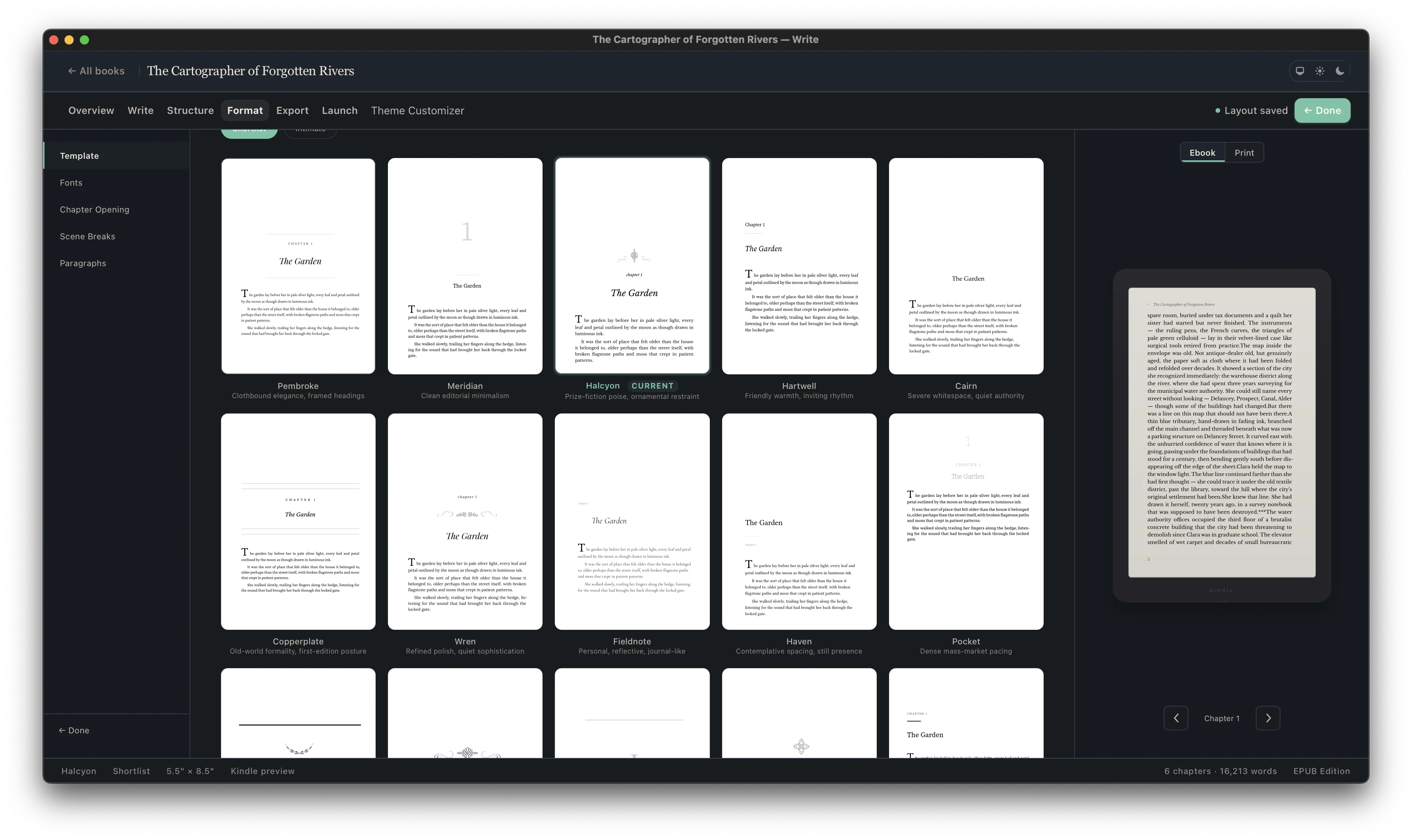
A template is useful only if it survives your content. Import or write the manuscript, choose an interior direction, set the edition, and inspect chapter titles, long pages, short pages, special extracts, images, front matter, and back matter in context.
Not every book needs every part. Decide intentionally, order the parts consistently, and test both the print and ebook navigation.
Define its place and hierarchy before final page composition.
Define its place and hierarchy before final page composition.
Define its place and hierarchy before final page composition.
Define its place and hierarchy before final page composition.
Keep the reader journey and future catalog updates in view.
Keep the reader journey and future catalog updates in view.
Keep the reader journey and future catalog updates in view.
Keep the reader journey and future catalog updates in view.
| Template element | Print edition | EPUB edition |
|---|---|---|
| Body typography | Exact type, size, line length, leading, and page composition | Styled defaults that yield to reader font and display choices |
| Chapter openings | Controlled page start and vertical position | Clear hierarchy without assuming a fixed physical page |
| Running heads and folios | Useful navigation with suppression rules | Omitted; the reading system provides location and navigation |
| Scene or section breaks | Spacing or ornament with page-boundary fallback | Semantic divider that remains visible as text reflows |
| Contents | Page-numbered list where the genre needs it | Linked navigation generated from structured headings |
| Images and extracts | Composed at exact size within the live area | Responsive treatment that survives narrow screens and enlarged type |
Reuse the design rules and structure, but let each book have its own clean project. That avoids carrying title-specific manual fixes into later volumes.
Usually, because consistent dimensions help the series feel unified. Change trim only for a deliberate edition or content reason.
Open each maintained source, update series order and back matter, then export fresh PDF and EPUB release files.
Yes. Cambric is a $199 one-time purchase for unlimited books.
Yes. The specific hierarchy differs, but the operating principle—document constants, preserve controlled variation, and maintain every source—applies to both.