Efficient chapter starts
Thrillers may have many short chapters. Excessive vertical space or forced recto starts can inflate page count and interrupt the intended pace.
Thrillers often use short chapters, rapid scene changes, timestamps, locations, and parallel timelines. The template should make every transition immediately clear without adding visual friction to a book built on pace.

Every interior decision works together: type, measure, rhythm, hierarchy, and the white space around the text.
The template should remain quiet through ordinary pages and become expressive only where the manuscript needs a transition.
9Use 5.25 × 8 or 5.5 × 8.5 with a compact readable serif, crisp chapter numbering, and a consistent secondary line for time, place, or POV. Keep the opener efficient so short chapters do not create excessive blank paper.
Genre signals matter, but consistency and readability are what make the interior feel professionally produced across hundreds of pages.
Thrillers may have many short chapters. Excessive vertical space or forced recto starts can inflate page count and interrupt the intended pace.
If chronology drives suspense, timestamps and locations need a consistent hierarchy that readers can scan without mistaking metadata for narrative.
Rapid cuts need a reliable break marker, especially when a new scene changes character or location without a full chapter.
Dialogue and short paragraphs can create visually ragged pages. Body settings should remain quick to read while controlling excessive white gaps and short final lines.
Trim establishes the physical page. Gutter, outside, top, and bottom margins define the live area and need to account for binding, page count, genre convention, and reading comfort.
Typeface, size, line length, leading, indentation, paragraph spacing, hyphenation, and widow/orphan behavior create the texture readers experience for most of the book.
Part, chapter, heading, extract, caption, list, and special-content styles tell readers what kind of information they are seeing and how it relates to the whole.
Headers and folios help navigation but need suppression rules for opening pages, front matter, blank pages, and any page where they compete with the content.
Chapter openings, section openers, scene breaks, and page turns control rhythm. They need visual clarity and fallback behavior when reflow places a transition near a boundary.
Print resolves exact pages. EPUB preserves semantic reading order and adapts to the device. One source should produce both without forcing fixed-page assumptions into reflowable text.
A thriller’s formatting should clarify cuts, not dramatize them. The prose and chapter sequence create tension. The interior makes that sequence instantly legible: a new chapter, a time jump, a location change, or a switch in point of view should never be visually ambiguous.
Define one metadata order and repeat it. Chapter number, title if any, time, location, and POV should not trade positions from chapter to chapter. Consistency makes unusual deviations more powerful when the story needs them.
Starting every three-page chapter far down the page or on a right-hand page can add dozens of mostly blank pages. That may be an intentional luxury for a premium edition, but often it is accidental. Test the full manuscript and see how the opener system affects page count and rhythm.
A compact opener can still feel designed through type, spacing, and a fine rule or small ornament. The goal is not to squeeze the book; it is to make white space proportional to the pace and product economics.
Ebooks remove stable page landmarks, so chapter headings and the table of contents carry more navigation weight. Avoid communicating a timeline only through page position or running heads. Put meaningful time and location information in the chapter structure itself.
When print and EPUB come from the same source, chronology labels and chapter order stay aligned. Inspect the ebook at several font sizes to ensure metadata does not become a detached or confusing block.
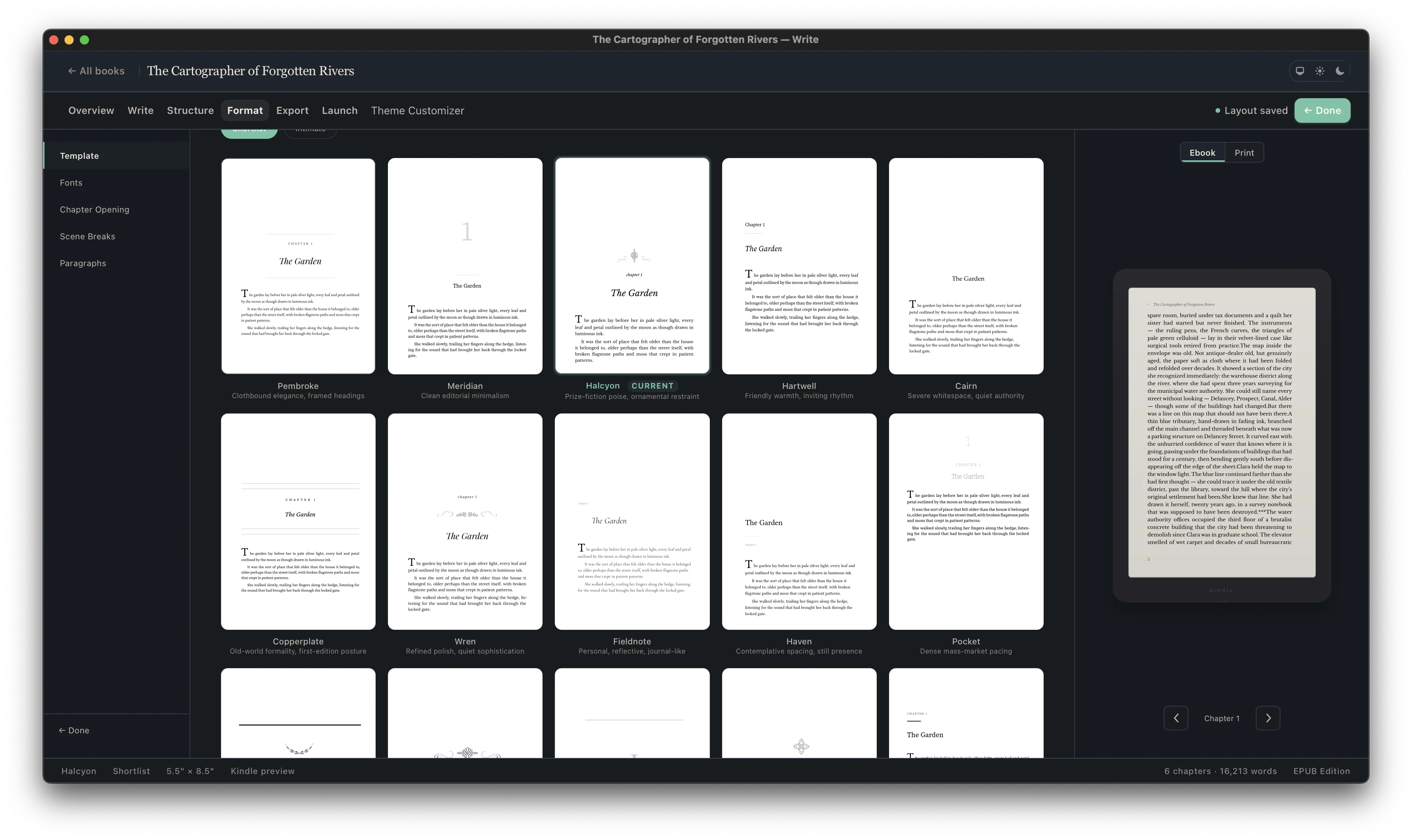
A template is useful only if it survives your content. Import or write the manuscript, choose an interior direction, set the edition, and inspect chapter titles, long pages, short pages, special extracts, images, front matter, and back matter in context.
Not every book needs every part. Decide intentionally, order the parts consistently, and test both the print and ebook navigation.
Define its place and hierarchy before final page composition.
Define its place and hierarchy before final page composition.
Define its place and hierarchy before final page composition.
Define its place and hierarchy before final page composition.
Keep the reader journey and future catalog updates in view.
Keep the reader journey and future catalog updates in view.
Keep the reader journey and future catalog updates in view.
Keep the reader journey and future catalog updates in view.
| Template element | Print edition | EPUB edition |
|---|---|---|
| Body typography | Exact type, size, line length, leading, and page composition | Styled defaults that yield to reader font and display choices |
| Chapter openings | Controlled page start and vertical position | Clear hierarchy without assuming a fixed physical page |
| Running heads and folios | Useful navigation with suppression rules | Omitted; the reading system provides location and navigation |
| Scene or section breaks | Spacing or ornament with page-boundary fallback | Semantic divider that remains visible as text reflows |
| Contents | Page-numbered list where the genre needs it | Linked navigation generated from structured headings |
| Images and extracts | Composed at exact size within the live area | Responsive treatment that survives narrow screens and enlarged type |
Usually not if chapters are short and numerous; forced recto starts can add excessive blanks. Use them only as a deliberate design and cost choice.
Create one consistent secondary heading level beneath the chapter identifier and use the same order and punctuation throughout.
5.25 × 8 and 5.5 × 8.5 are common, though 6 × 9 may suit long or nonfiction-adjacent titles. Test page count and market positioning.
They need an opener system that preserves momentum and controls page inflation. Otherwise the same core fiction typography rules apply.
Yes. Use structured chapter labels for dates, periods, locations, or POV and keep that hierarchy consistent in both print and ebook.